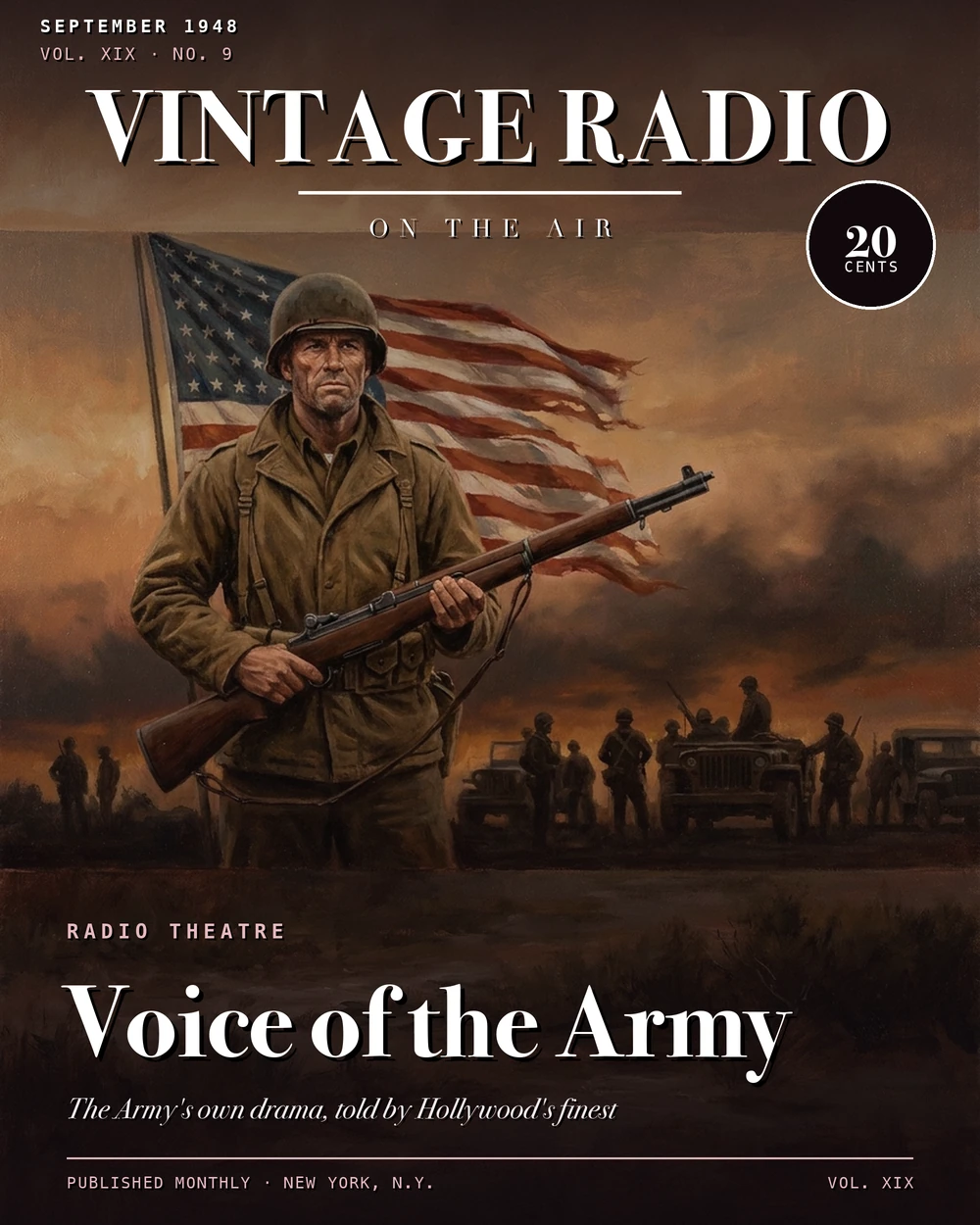
Voice of the Army
What It Was and How It Worked
Voice of the Army ran from the early 1940s into the early 1950s, produced by the U.S. Army Recruiting Publicity Bureau and sponsored jointly by the U.S. Army and the Army Air Force. Over that decade-plus run the series generated more than 500 episodes, distributed to radio stations on 16-inch transcription discs — the standard method by which the Armed Forces Radio Service reached stations both stateside and worldwide. It was a direct recruiting instrument, and it didn't pretend otherwise: each episode closed with a brief message aimed at young men and women considering military service.
The format was an anthology, which gave the producers flexibility to chase whatever the Army most needed to say at a given moment. During World War II the show leaned heavily on stories about Army nurses, hoping to encourage women to volunteer. In the immediate post-war years the pitch shifted toward persuading men to re-enlist. By the late 1940s it had evolved into something closer to a variety and dramatic anthology, drawing on Hollywood names and working musicians to hold an audience that wasn't necessarily tuning in for a sales pitch. The content changed; the closing recruiting message stayed.
The episode numbers tell the story plainly. Episode 213 dates to around 1944, episode 303 to around 1946, episode 418 to August 1, 1948, and episode 448 to 1949. The 49 episodes that survive in any known collection represent a small fraction of what was produced — most of the run is simply gone.
The Stars Who Showed Up
Given the Army's access to the Hollywood talent pool during and after the war, the guest lists on Voice of the Army could be remarkable. Jimmy Stewart narrated an episode called "Flying Dutchman" — episode 448, broadcast in 1949 — alongside Sam Edwards, Jeff Chandler, Don Oreck, and Bill Martell, with Rye Billsbury announcing. Stewart's wartime service as an Air Force officer gave appearances like his a credibility a purely civilian star couldn't have matched.
Other documented performers across the run include Henry Fonda, Gloria Swanson, Pat O'Brien, Frank Lovejoy, Nat King Cole, and Arlene Francis. Edward R. Murrow appeared, as did broadcaster and sportswriter Bill Stern and classical music host Milton Cross. The DeMarco Sisters provided music on at least one episode, and tennis champion Alice Marble turned up in the documented lineup as well. Tex McCrary — a WWII Air Corps colonel who had also pioneered the radio talk-show format with his wife Jinx Falkenburg — starred in the "America Grows Wings" episode. Adolphe Menjou appeared in "Front Line Leader." John Hodiak featured in "Treasures From Salt Mines," and John Dall in "In The Bag." Dick Hogan starred in "What's In A Name," and Johnny Mack Brown — the football star turned Western-movie cowboy — carried "The Star Spangled Banner."
The musical episodes drew from wherever the Army could reach. Ethel Smith, the Hammond organist who had a genuine pop hit with "Tico Tico" in 1944, appeared in an episode called "Keyboard Capers." Jane Pickens performed in "Music For All." "Musical Almanac" starred John Conte and Johnnie Guarnieri. Abe Burrows, the writer and performer who was a fixture of early television and Broadway, had his own episode. The variety instinct is obvious — these weren't just dramatic readings, they were entertainment vehicles with a recruiting message bolted to the end.
The Episode That Won an Award
One episode stands out in the documented record. "Names on the List," episode 213 in the series and dated to around 1944, starred Helen Hayes and was written by Cpl. Jacques Finke and Cpl. Donald Agger. It won an Ohio State Citation in 1945. The Ohio State Institute for Education by Radio gave those citations to programs judged to have used the medium well in the public interest, so the recognition meant something beyond a government pat on the back. That two Army corporals wrote the winning script says something about where the talent was coming from — the military had drafted a lot of people who knew how to write radio drama.
The show also marked significant military anniversaries when it could. On the one-year anniversary of the establishment of the U.S. Air Force — created as an independent branch in 1947 — Voice of the Army ran episodes focused on air combat stories. That kind of timely programming reinforced the show's identity as an official voice, not just background entertainment.
What Survives
The full run of Voice of the Army crossed somewhere north of 500 episodes over roughly a decade, and the overwhelming majority of that output has not survived. The 49 episodes that remain are a sample drawn from the later portion of the run — the episode numbers place them in the 400s range, meaning the catalog catches the show well into its stride but misses the World War II years almost entirely, including the nursing recruitment arc and the earliest dramatic work.
The surviving episodes circulated on 16-inch transcription discs, the same distribution format the Armed Forces Radio Service used from its establishment in May 1942 onward. That format was durable enough to preserve what made it through, but the sheer volume of production and the limited institutional impulse to archive government radio programming meant most of it wasn't kept. What remains is enough to document the show's variety-anthology character in its later phase, the caliber of performers the Army could attract, and the consistent recruiting function the format served from the opening dramatic sequence through to the closing appeal.